Understanding the Hidden Risks
A vessel’s Power Management System (PMS) is essential for a reliable electrical power supply. It controls generators, manages electrical loads, synchronises power sources and coordinates the transfer between shore power and onboard generation.
Many yachts still use their original PMS after 10, 15 or even 20 years. While these systems may appear to work normally, electronic components deteriorate over time, and spare parts become increasingly difficult to obtain.
A functioning Power Management System is not necessarily a healthy or safe system.
1. Hidden Risks of Ageing Electronics
Marine electronic equipment operates in demanding conditions. Temperature changes, humidity, vibration and corrosion can gradually affect electronic components, electrical connections, insulation and plastic housings.
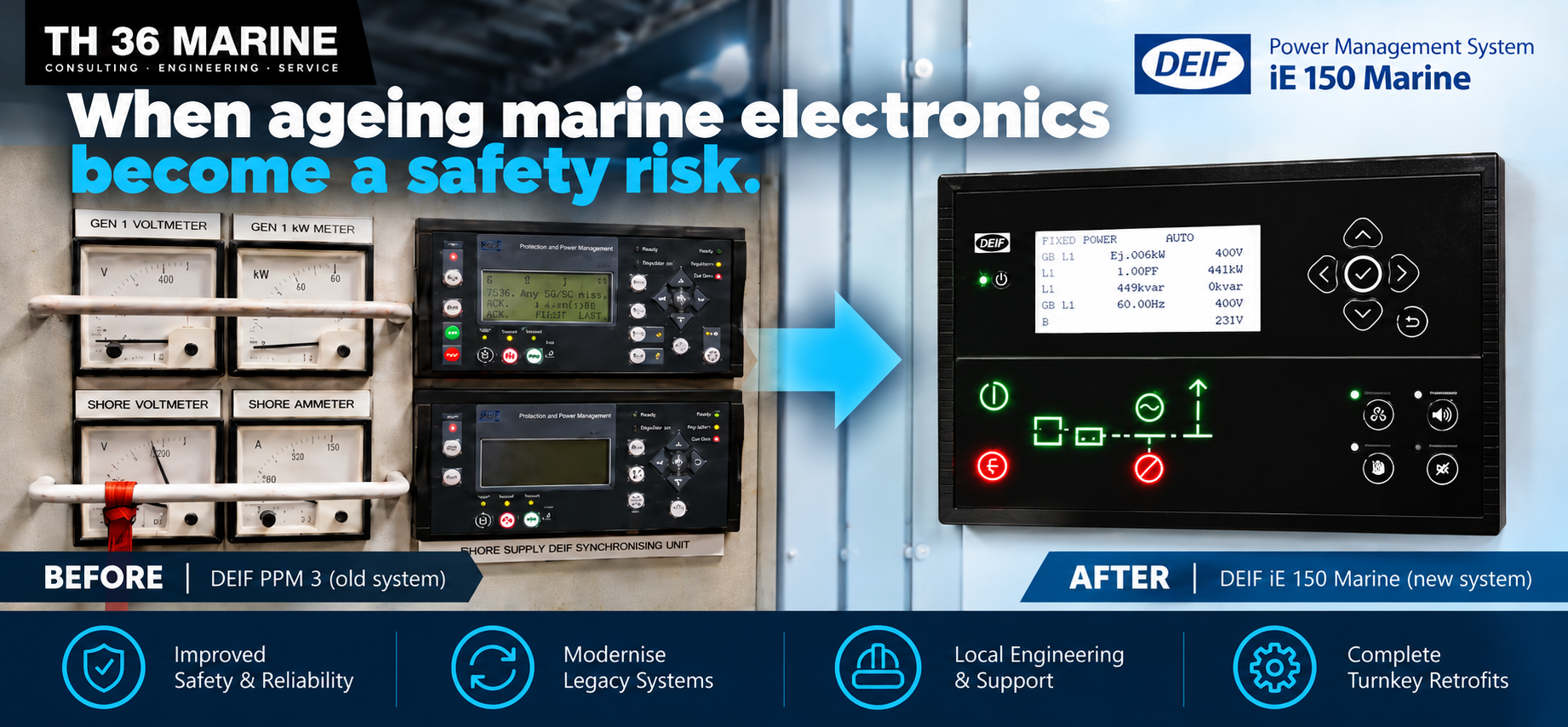
During a recent DEIF Power Management System retrofit on a motor yacht, TH 36 Marine encountered a clear example of this deterioration.
The original system had reached an advanced age, and its controller housings had become extremely brittle. Like potato chips, the plastic would break and crumble under even slight mechanical pressure. Some units were held together and kept in place with electrical tape and cable ties.

Internal electrical components connected to the vessel’s main electrical busbar were exposed due to the damaged controller housings, creating serious electrical safety hazards.
Accidental contact or an electrical fault could cause electric shock, short circuits or electrical arcing, potentially leading to fire or a vessel blackout.
Despite the safety and operational risks associated with its deteriorated condition, the Power Management System remained in service for years. Spare parts were no longer available, and no suitable turnkey retrofit solution had been offered to replace the ageing system.
2. What Happens When a PMS Fails?
The Power Management System is at the heart of a yacht’s electrical power supply. It manages the generators, controls their connection to the electrical network, balances electrical loads and coordinates the transfer between shore power and onboard generation.
If the PMS fails, the vessel’s electrical power sources can no longer be coordinated properly.
This can cause:
- Blackout: Loss of electrical power to essential onboard systems.
- Loss of generator control: Generators may still be running but cannot be connected, synchronised or managed properly.
- Generator overload: Failure to manage electrical loads can overload generators and cause them to trip.
- Electrical damage: Incorrect synchronisation or switching can damage generators, switchgear and connected equipment.
- Shore-power problems: The vessel may lose shore power or be unable to transfer between shore power and onboard generators.
- Operational restrictions: The yacht may be unable to depart or continue operating safely.
A PMS failure can therefore leave a yacht without a reliable electrical power supply, even when the generators themselves are fully operational.
3. Obsolescence and Spare-Part Availability
Physical deterioration is only one concern. Product obsolescence can make maintaining older Power Management Systems increasingly difficult.
Over the years, DEIF has introduced several generations of marine power management controllers, including the PPU-2, PPM-2, PPM-3 and PPM 300, followed by the latest iE series.
As older generations are phased out, spare parts, repair options and technical support become increasingly limited. In some cases, replacement controllers are no longer available.
Replacing obsolete controllers with newer systems requires modifications to wiring, communication, configuration and control functions. Differences in dimensions and mounting arrangements may also require changes to panel cutouts or cabinet layouts, as the new controllers may not fit into the existing spaces.
An operational system without reliable spare-part support can represent a significant risk to vessel availability.
4. When Should a PMS Be Inspected or Replaced?
There is no universal replacement age for marine electronic systems. Their service life depends on operating conditions, maintenance, component condition and continued manufacturer support.
TH 36 Marine recommends the following lifecycle approach:
| System age | TH 36 Marine recommendation |
| Under 10 years | Follow manufacturer maintenance recommendations. |
| 10–15 years | Comprehensive specialist Health Check recommended, followed by regular condition-based inspections. |
| 15–20 years | Begin retrofit planning and continue regular specialist Health Checks based on system condition. |
| Over 20 years | Planned retrofit highly recommended, particularly for obsolete or unsupported systems. |
These are TH 36 Marine engineering recommendations, not manufacturer-defined replacement intervals.
The objective is not to replace equipment simply because of its age, but to understand its condition and associated risks.
Our recent retrofit illustrates how ageing equipment and severe physical deterioration can make replacement necessary, even before a complete system failure occurs.
5. Warning Signs Are Often Overlooked
Ageing electronic systems do not always show clear warning signs before a failure.
Common warning signs can include damaged or brittle housings, corrosion, intermittent communication problems, unexplained alarms, unstable measurements and unexpected generator or circuit-breaker behaviour.
However, these signs are often overlooked because deterioration develops gradually, and the condition of the equipment becomes accepted as normal during everyday operation. Maintenance or replacement may also be postponed due to operational demands or costs, without fully recognising the risks involved.
Our recent retrofit is a clear example of how serious deterioration can become part of everyday operation without receiving the attention it requires.
Recognising these warning signs early allows problems to be addressed before they lead to a serious failure.
6. Planned Retrofit Versus Emergency Repair
Our recent motor yacht retrofit demonstrates the value of identifying ageing equipment and planning its replacement before a complete system failure occurs.
A planned retrofit gives vessel owners greater control over the location, timing, engineering and costs, while an unexpected failure can leave very few options.
| Planned retrofit | Emergency repair |
| Suitable location selected | Repair wherever the vessel is located |
| Scheduled downtime | Unexpected operational interruption |
| Engineering prepared in advance | Urgent troubleshooting and engineering |
| Components sourced beforehand | Uncertain spare-part availability |
| Defined scope and budget | Unplanned costs |
| Controlled testing and commissioning | Pressure to restore operation quickly |
For commercially operated yachts, unexpected downtime may also result in cancelled charters and lost revenue.
Early planning helps reduce operational risks, avoid unnecessary costs and ensure the retrofit can be carried out under controlled conditions.
7. Modernising an Existing Installation
Replacing an ageing Power Management System does not necessarily require replacing the entire electrical switchboard.
In our recent retrofit, TH 36 Marine provided the customer with the first complete turnkey solution for their ageing DEIF Power Management System, covering engineering, equipment selection, installation, integration, configuration, testing and commissioning.
The existing installation was modernised with new controllers, requiring modifications to wiring, communication, control functions and cabinet layouts, as well as integration with the vessel’s existing Böning Alarm and Monitoring System. Particular attention was given to generator synchronisation, circuit-breaker control, electrical protection and shore-power transfer.

With engineering and commissioning handled locally, TH 36 Marine provides direct access to qualified expertise, crew training and ongoing technical support, with assistance available whenever needed.
A properly engineered retrofit allows suitable existing equipment to remain in service while replacing ageing and obsolete control technology.
8. The Value of a Specialist Health Check
A specialist PMS Health Check helps identify developing problems and assess the condition, safety and continued supportability of the system.
The assessment considers the overall condition of the Power Management System, including its electronic components, electrical connections, associated switchgear, system configuration and operational functions. Spare-part availability and manufacturer support are also taken into account.
The findings help determine whether continued operation, targeted maintenance or a planned retrofit is the most appropriate solution.
For ageing installations, this provides valuable information for maintenance planning and budgeting.
9. Conclusion: Plan Before a Failure Makes the Decision
An ageing Power Management System may continue operating normally while its components deteriorate and replacement parts become difficult to obtain.
Our recent DEIF retrofit illustrates how serious physical deterioration can develop before a complete system failure occurs.
For vessels with systems older than 10 years, a specialist Health Check is a sensible first step. For installations approaching 15–20 years, retrofit planning should become part of the long-term maintenance strategy.
Regular Health Checks cannot eliminate unexpected failures or downtime. However, they help identify potential risks and provide valuable time to plan maintenance or a retrofit under controlled conditions.
TH 36 Marine – Power Management System Health Checks & Retrofit
TH 36 Marine supports yacht owners, captains and technical managers with DEIF Power Management System Health Checks, engineering, integration and retrofits. Our expertise also includes Aventics Marex OS propulsion remote control systems and Böning Alarm and Monitoring Systems, allowing us to support the integration of these systems within the vessel’s existing automation environment.
Contact TH 36 Marine to discuss the condition of your existing Power Management System or plan its modernisation.